
In today’s fast-moving world, the brain rarely gets a moment of silence.
We wake up to notifications, scroll through headlines, reply to endless messages, and juggle dozens of thoughts before we’ve even had breakfast.
The modern mind is overloaded — too much information, too many choices, too little peace.
We spend so much time thinking, planning, and worrying that our mental space becomes cluttered — like a desk buried under piles of unnecessary papers.
And just like that messy desk, a cluttered mind can’t find what truly matters.
This is where mental minimalism comes in.
Mental minimalism isn’t about thinking less because you’re lazy — it’s about thinking intentionally.
It’s the conscious choice to clear mental clutter, reduce decision fatigue, and create space for clarity, creativity, and calm.
It’s not a trend — it’s a survival skill for the overstimulated modern brain.
As Steve Jobs once said:
“Simplicity is the ultimate sophistication.”
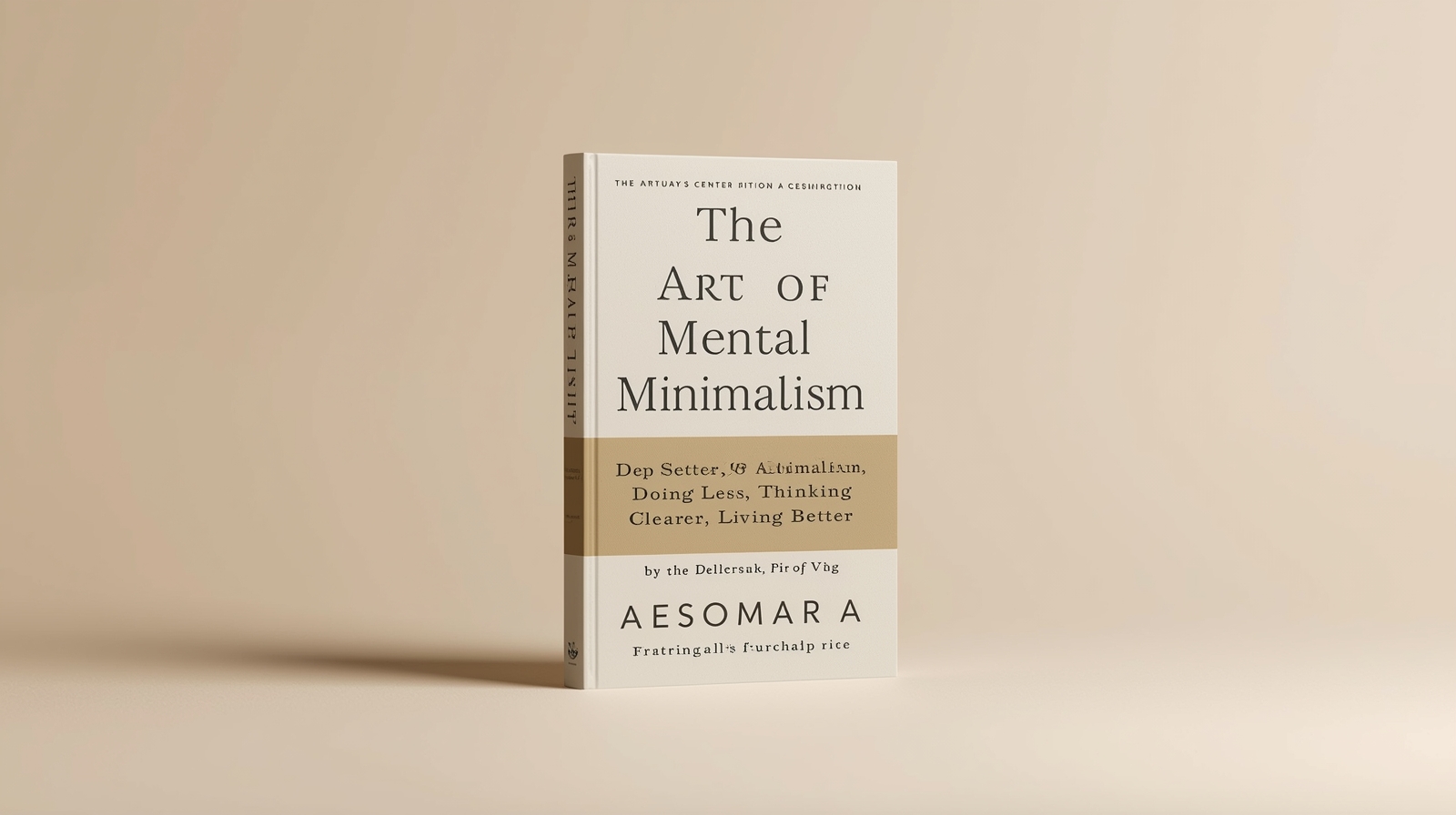
In this guide, we’ll explore the art and science of mental minimalism — how to do less, think clearer, and live better through small, intentional shifts in your mental habits.
🧠 What Is Mental Minimalism?
Just as physical minimalism is about owning fewer things, mental minimalism is about owning fewer thoughts.
It’s not about erasing your mind — it’s about filtering it.
When you practice mental minimalism, you:
- Prioritize clarity over clutter.
- Focus on what truly matters.
- Release unnecessary worries and overthinking.
- Create space for rest, creativity, and insight.
It’s a mindset shift from “How much can I handle?” to “What truly deserves my attention?”
As Cal Newport, author of Deep Work, explains:
“Clarity comes from doing less, but doing it better.”
Mental minimalism is your brain’s way of decluttering the noise and returning to what feels grounded, purposeful, and peaceful.
⚙️ The Science Behind a Cluttered Mind
Your brain was never designed to process the amount of information it faces today.
According to Harvard University research, the average person now consumes over 34 gigabytes of information daily — equivalent to reading 174 newspapers a day.
That’s not productivity — that’s cognitive overload.
Each new input (email, message, notification, decision) drains mental energy and taxes your prefrontal cortex, the part of your brain responsible for focus and decision-making.
Stanford University studies show that multitasking lowers IQ temporarily and increases cortisol — the stress hormone — leading to fatigue and anxiety.
When the mind is overstimulated, it can’t distinguish between what’s urgent and what’s important.
Everything feels equally loud.
Mental minimalism helps quiet that internal noise by simplifying how you think, what you consume, and where you focus your attention.
🌸 Step 1: Declutter Your Inner Dialogue
The first step toward mental minimalism is to simplify the way you talk to yourself.
Overthinking often comes from self-criticism or unrealistic expectations.
You might notice thoughts like:
- “I should have done more.”
- “What if I fail?”
- “I need to do everything right.”
This mental chatter creates pressure loops that keep your brain in overdrive.
🧘♂️ Try This 5-Minute Reset:
- When a negative thought arises, pause.
- Ask: “Is this thought helpful or just noise?”
- If it’s noise, breathe it out.
- Replace it with a calm truth — like: “I’m doing my best right now.”
“It’s okay to pause.”
According to UCLA’s Mindfulness Research Center, labeling and reframing thoughts reduces activity in the amygdala — the brain’s fear center — and enhances emotional clarity.
Your mind becomes lighter when you stop believing every thought it throws at you.
🪞 Step 2: Choose Fewer, Better Thoughts
Every day, your brain generates over 60,000 thoughts, according to the National Science Foundation.
But 95% of them are repetitive — the same loops of worry, doubt, or distraction.
Mental minimalism invites you to become intentional about which thoughts you entertain.
💡 Ask yourself:
“Does this thought deserve my energy?”
You’ll find that most thoughts don’t — they’re just passing noise.
This practice is called selective attention, and it’s backed by neuroscience.
By focusing only on thoughts that align with your goals or peace, you reduce decision fatigue and mental clutter.
🧠 Quick daily practice:
At the start of your day, write down three words that describe the mindset you want to keep (e.g., “calm,” “focused,” “grateful”).
Throughout the day, if a thought doesn’t fit those words — let it go.
This helps train your mind to choose focus over frenzy.
🧩 Step 3: Simplify Your Decisions
Decision fatigue is one of the biggest causes of mental exhaustion.
Every choice — big or small — burns glucose and mental energy.
That’s why by evening, even simple decisions like “What should I eat?” feel overwhelming.
Mental minimalists reduce decision fatigue by creating systems, not choices.
🛠️ Here’s how:
- Simplify your routine: Eat similar healthy meals, wear staple outfits, or plan weekly tasks in advance.
- Use “default decisions”: Automate minor choices (e.g., “I walk after lunch every day”).
- Create clear priorities: Decide what truly matters each day — and let the rest wait.
Harvard psychologist Daniel Gilbert notes that when people make fewer, more meaningful decisions, their happiness and satisfaction rise dramatically.
Doing less decision-making doesn’t make life boring — it makes it peaceful.
🕯️ Step 4: Manage Mental Inputs
You can’t declutter your mind if you keep filling it with noise.
Social media, news, podcasts, and constant notifications flood your brain with unnecessary information.
A Stanford study found that “information overload” decreases attention span and increases stress even when the information seems harmless.
🧘 Try the “Mental Diet” Method:
- Unfollow accounts that drain or distract you.
- Read fewer, deeper things instead of endless short content.
- Take digital breaks — 15 minutes of silence for every hour online.
Quality over quantity applies to information too.
Your mental environment shapes your inner peace — curate it with care.
🌤️ Step 5: Prioritize Presence Over Productivity
Modern culture worships busyness — but busyness isn’t fulfillment.
Mental minimalism flips the script: it’s not about doing more, but being more present in what you do.
Presence is where clarity and joy live.
💡 Practice this mantra:
“I can’t do everything, but I can do this one thing well.”
When you give full attention to a single moment — writing an email, eating lunch, or talking with someone — your mind stops scattering energy and starts focusing powerfully.
This practice aligns with Stanford’s “single-tasking” research, which shows that doing one task at a time improves performance and reduces perceived stress by 40%.
🌿 Step 6: Create Mental White Space
White space in design gives the eyes rest.
Mental white space does the same for your brain.
It’s intentional nothingness — a few minutes without stimulation, sound, or obligation.
You can find it through:
- Short walks without your phone.
- Sitting quietly before bed.
- Taking a shower mindfully.
According to Harvard Health, moments of mental stillness activate your brain’s default mode network, which helps with creativity, memory consolidation, and emotional balance.
💬 Try this:
Once a day, do nothing for five minutes. No scrolling, no tasks — just breathe.
That’s not wasted time. That’s restoration time.
💧 Step 7: Let Go of Perfection
Perfection is mental clutter disguised as ambition.
When you try to make everything flawless — your work, relationships, or plans — your brain stays in constant judgment mode.
Letting go of perfection is a cornerstone of mental minimalism because it frees energy from unrealistic expectations.
A 2020 University of Toronto study found that perfectionists experience 70% more mental fatigue due to constant self-monitoring and over-analysis.
Instead, replace perfection with progress.
💬 Say to yourself:
“Done is better than perfect.”
“Peace matters more than polish.”
Progress builds momentum — and mental peace thrives in motion, not obsession.
🧘 Step 8: Redefine Success
Our society equates success with busyness.
But real success is clarity, purpose, and peace of mind.
Mental minimalism invites you to redefine success as alignment, not accumulation.
Ask yourself:
- “What actually fulfills me?”
- “What am I doing out of obligation instead of joy?”
Living simply doesn’t mean living small — it means focusing energy on what feels meaningful.
According to Yale’s Center for Emotional Intelligence, people who define success by internal peace rather than external validation report higher life satisfaction and lower burnout.
Your best life may not require more — just less of what doesn’t serve you.
🌙 Step 9: Sleep and Mental Reset
Sleep is your brain’s most powerful form of minimalism — a nightly declutter.
During deep sleep, your brain’s glymphatic system literally washes away metabolic waste and resets cognitive function.
When you sacrifice sleep for productivity, you accumulate mental residue — fatigue, fog, and irritability.
The National Institutes of Health found that even one night of poor sleep reduces attention and emotional regulation by up to 30%.
💤 Practice “sleep minimalism”:
- Set consistent bedtimes.
- Dim screens an hour before bed.
- Keep your sleep environment quiet and uncluttered.
Rest isn’t lazy. It’s essential maintenance for a clear, calm mind.
☀️ Step 10: The Minimal Mindset in Daily Life
Mental minimalism is a practice, not a destination.
You integrate it through daily choices, micro-habits, and perspective shifts.
Here’s a simple daily flow to live with more clarity and less noise:
| Time | Mental Minimalism Practice | Purpose |
|---|---|---|
| Morning | 2 minutes of silent breathing | Begin with clarity |
| Work | Single-tasking and focus breaks | Reduce overwhelm |
| Midday | 5-minute thought reset | Refresh mental energy |
| Evening | Digital sunset | Create calm closure |
| Night | Gratitude or reflection | End with peace |
Consistency, not intensity, builds clarity.
🌻 Step 11: The Benefits of Thinking Less
When you embrace mental minimalism, life doesn’t get emptier — it gets lighter.
You begin to notice:
- Calmer mornings — without the rush of anxious thoughts.
- Sharper focus — because your mind isn’t juggling distractions.
- Deeper creativity — because silence gives space for inspiration.
- Better relationships — because presence replaces preoccupation.
As Carl Jung wisely said:
“Your vision will become clear only when you look into your heart.
Who looks outside, dreams. Who looks inside, awakens.”
Mental minimalism helps you return to that inner clarity — the space where peace naturally lives.
🔬 Backed by Research: The Science of Doing Less
Numerous studies support the benefits of simplifying your mental life:
- Harvard University (2020): Mindfulness and simplification improve memory and reduce anxiety by 35%.
- Stanford University (2019): Monotasking improves focus and emotional regulation by 40%.
- UCLA (2021): Labeling thoughts decreases stress and increases emotional control.
- Yale University (2020): Internal measures of success predict higher happiness and lower burnout.
- NIH (2021): Adequate rest improves mental processing and emotional resilience.
Minimalism isn’t just aesthetic — it’s neurological.
🌙 Conclusion: Clarity Is the New Luxury
We live in a world that celebrates more — more goals, more data, more everything.
But peace doesn’t come from addition. It comes from subtraction.
Mental minimalism is the quiet rebellion of choosing less — fewer worries, fewer distractions, fewer unnecessary obligations — so that you can finally hear yourself think.
When you practice it, you’ll discover something profound:
Your best ideas, your deepest calm, and your truest self have been waiting beneath the noise all along.
“A clear mind is not an empty mind — it’s a focused one.”
So simplify your thoughts.
Do less.
Think clearer.
And live infinitely better.
🧾 Research References
- Harvard University, Information Overload and Cognitive Fatigue, 2020
- Stanford University, Multitasking and Stress Correlation, 2019
- UCLA Mindfulness Research Center, Labeling and Emotional Regulation, 2021
- Yale Center for Emotional Intelligence, Internal Success Metrics and Well-being, 2020
- University of Toronto, Perfectionism and Mental Fatigue, 2020
- National Institutes of Health, Sleep and Cognitive Function, 2021
- Cal Newport, Deep Work, 2016