
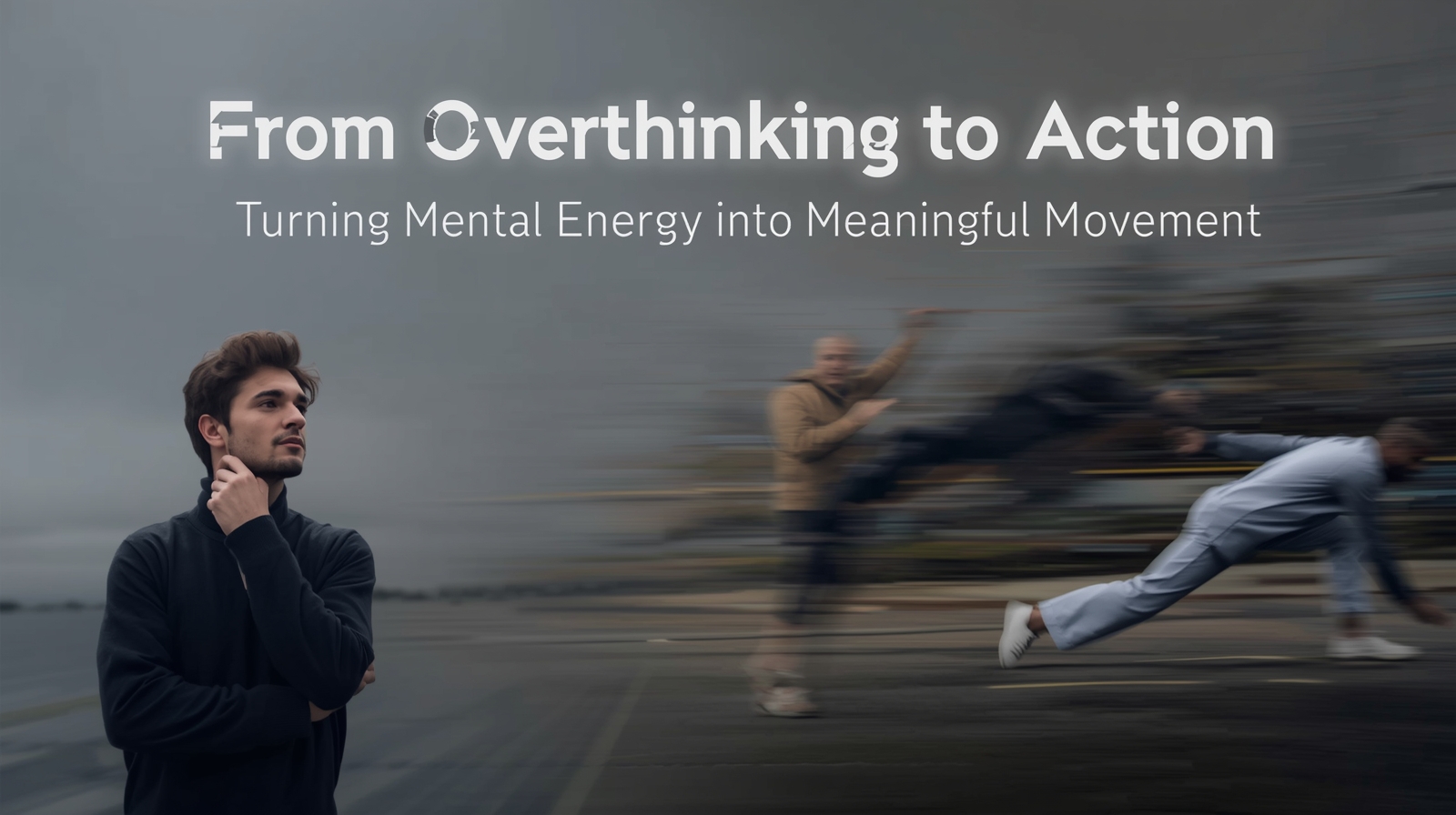
Have you ever spent hours analyzing a decision, running through “what ifs” in your head, and still ended up stuck in place? Overthinking can feel like a mental treadmill — your mind spins endlessly, but your life doesn’t move forward.
The good news: mental energy can be redirected. Instead of being trapped in thought loops, you can transform your overthinking into meaningful action, creating momentum, purpose, and tangible results.
This article explores practical strategies, science-backed techniques, and human-centered advice to convert rumination into productive movement — so you can reclaim your energy, focus, and confidence.
🧠 Understanding Overthinking
Overthinking is more than just a bad habit — it’s a cognitive pattern. Psychologists describe it as repetitive, negative, and analytical thought loops, often triggered by stress, uncertainty, or perfectionism.
Key characteristics include:
- Ruminating on the past — replaying events or mistakes repeatedly.
- Worrying about the future — imagining potential problems before they occur.
- Indecision paralysis — feeling unable to act despite clarity on the next steps.
Neuroscience explains this through overactivation of the prefrontal cortex, combined with reduced activity in motor and reward centers, which keeps the brain “thinking” instead of “doing.”
⚡ The Cost of Overthinking
Overthinking isn’t harmless. Chronic rumination can:
- Increase cortisol levels, leading to stress and fatigue.
- Reduce dopamine, lowering motivation and pleasure.
- Interfere with decision-making and productivity.
- Contribute to anxiety and depression over time.
Studies in Frontiers in Psychology highlight that prolonged rumination can deplete mental energy, making it harder to initiate even small actions.
The solution? Transform mental energy into physical or cognitive action.
🌱 Step 1: Recognize and Acknowledge Thought Loops
The first step in moving from overthinking to action is awareness.
- Identify when you’re stuck in repetitive thinking.
- Name it: “I’m ruminating about X.”
- Accept that the thoughts are happening without judging yourself.
This simple recognition activates metacognition, a higher-order brain function that helps you step out of the loop and regain control.
🏃 Step 2: Take Micro-Actions
Action breaks the cycle of overthinking. Even tiny steps create momentum.
Examples:
- Send that one email you’ve been delaying.
- Write a single bullet point of a plan.
- Stand up, stretch, or walk for two minutes.
According to James Clear (Atomic Habits), small wins trigger dopamine, which reinforces behavior and makes larger tasks feel achievable.
Key principle: Start small. Action doesn’t have to be perfect — it just has to move you forward.
🔄 Step 3: Externalize Thoughts
Putting thoughts into physical or visual form converts abstract mental energy into tangible action:
- Journaling: Write worries, ideas, and solutions.
- Mind maps: Break a complex problem into actionable steps.
- Voice memos or recordings: Speaking your thoughts out loud organizes them cognitively.
Externalizing reduces cognitive load and creates clarity, helping your brain focus on actionable steps rather than endless rumination.
🧘 Step 4: Combine Mind and Body
The body is a powerful tool for redirecting mental energy:
- Mindful walking: Pay attention to steps, breath, and surroundings while thinking through solutions.
- Stretching or yoga: Moves blood and oxygen, calming the nervous system and stimulating clarity.
- Physical tasks: Cleaning, organizing, or cooking can help the mind process thoughts while generating tangible outcomes.
Research from Harvard Medical School shows that light physical movement reduces anxiety and improves executive function, making decision-making easier.
💡 Step 5: Time-Box Thinking
Overthinking often arises when there’s no limit on mental processing. Combat this with time-boxing:
- Set a timer (5–15 minutes) to think about the issue.
- Use that time to brainstorm solutions, not ruminate.
- When the timer ends, take immediate action — even a small step.
This technique reduces mental fatigue and encourages movement over endless analysis.
🌀 Step 6: Use the “Two-Minute Rule”
Inspired by productivity research, if a task takes less than two minutes, do it immediately.
- Reply to an email.
- Make a call.
- Schedule a meeting.
This principle turns thinking into doing, and multiple two-minute actions compound into significant momentum over time.
🌟 Step 7: Prioritize and Simplify Decisions
Decision fatigue intensifies overthinking. Combat it by:
- Listing priorities: Focus on the top 1–3 tasks for the day.
- Eliminating choices: Pre-decide meals, clothing, and routines.
- Breaking tasks into actionable steps: Complex problems become manageable.
According to Psychology Today, simplifying decisions preserves mental energy and makes it easier to move from thought to action.
🧩 Step 8: Embrace Imperfection
Overthinkers often wait for the “perfect” plan or solution.
- Shift mindset from “perfect” to “good enough.”
- Allow mistakes to happen as part of learning.
- Recognize that action itself produces clarity, while overthinking produces doubt.
Cognitive Behavioral Therapy (CBT) research shows that accepting imperfection reduces anxiety and increases task initiation.
🏞 Step 9: Create Physical Anchors
Anchors are physical cues that redirect mental energy toward action:
- Standing up before starting a task.
- Walking to another room to brainstorm.
- Using a specific object (like a notebook or pen) to signal work mode.
Physical anchors prime the motor system, linking intention with execution and reducing the gap between thought and action.
🔋 Step 10: Use Visualization to Motivate Action
Visualization isn’t just daydreaming — it’s a neuroscientific tool:
- Imagine completing the task successfully.
- Engage senses: feel the movement, hear feedback, see results.
- Pair visualization with immediate small action.
Studies from NIH show that mental rehearsal activates the same brain regions as physical execution, bridging the gap between planning and action.
🧘 Step 11: Mindful Pausing
Paradoxically, pausing can restore energy for action:
- Take deep breaths or short meditative breaks.
- Focus on body sensations, grounding yourself in the present.
- Return to the task with renewed clarity and reduced mental clutter.
Mindful pauses replenish dopamine and reduce cortisol, creating the optimal state for action.
🌅 Step 12: Build Momentum Through Consistency
Momentum is the antidote to overthinking.
- Start with micro-actions daily.
- Celebrate each small win.
- Gradually increase task complexity.
The principle is simple: motion creates motivation, and repeated action builds confidence, reducing the tendency to overthink future tasks.
🌟 Step 13: Accountability and Support
External support strengthens internal motivation:
- Share your plans with a trusted friend, colleague, or coach.
- Use progress tracking tools or habit trackers.
- Reflect weekly on accomplishments and lessons learned.
Research shows that social accountability increases follow-through by up to 95%, effectively transforming thought into action.
🔄 Step 14: Energy Management, Not Just Willpower
Overthinking often depletes energy faster than it solves problems. Manage energy:
- Schedule high-focus tasks during peak energy periods.
- Take short movement or breath breaks.
- Eat nutrient-rich foods to fuel cognition.
Energy-aware action is more effective than relying solely on willpower.
💬 Step 15: Real-Life Application
- Emma, 29, Marketing Executive: Spent weeks overanalyzing a presentation. She used micro-actions — drafting one slide at a time — and completed it with confidence.
- James, 42, Entrepreneur: Combated indecision by pairing walking meetings with brainstorming. Mental energy transformed into actionable strategies.
- Sofia, 34, Teacher: Converted classroom planning stress into focused prep sessions with mindful movement and journaling.
These examples demonstrate how mental energy, when harnessed effectively, produces tangible outcomes and renewed motivation.
🧾 Quick Reference Table: Overthinking to Action Strategies
| Strategy | Benefit |
|---|---|
| Micro-actions | Immediate progress, dopamine boost |
| Externalization (journaling/mind maps) | Reduces cognitive load, clarity |
| Mindful movement | Lowers stress, improves cognition |
| Time-boxing | Limits rumination, increases productivity |
| Two-minute rule | Turns small ideas into action |
| Prioritization | Reduces decision fatigue |
| Imperfection acceptance | Reduces anxiety, increases initiative |
| Physical anchors | Links intention to movement |
| Visualization | Bridges thought and execution |
| Mindful pauses | Replenishes mental energy |
| Consistency | Builds momentum and confidence |
| Accountability | Increases follow-through |
| Energy management | Sustains focus and motivation |
🌠 Conclusion: Transform Thought Into Movement
Overthinking can feel immobilizing, but mental energy is not wasted — it’s waiting to be redirected into meaningful action.
- Recognize thought loops.
- Start small, act immediately, and celebrate micro-wins.
- Use movement, visualization, and mindful pauses to fuel clarity.
- Build momentum through consistency and energy management.
By consciously turning mental energy into purposeful movement, you reclaim your time, focus, and confidence. Life becomes less about spinning in circles and more about moving forward with intentionality and momentum.
🧾 References
- Csikszentmihalyi, M. Flow: The Psychology of Optimal Experience, 2008
- Harvard Business Review, The Progress Principle, 2010
- Psychology Today, The Neuroscience of Rumination, 2021
- James Clear, Atomic Habits, 2018
- NIH, Neuroplasticity and Habit Formation, 2019
- Frontiers in Psychology, Ruminative Thought and Cognitive Load, 2020